Can You Have a Hair Transplant with Thin Donor Hair? Results, Limitations and Options
A common concern for patients considering treatment is: can you have a hair transplant with thin donor hair?
If you are concerned about thin donor hair or low donor density, understanding how this affects your hair transplant options is essential.
The donor area plays a central role in any hair transplant. It provides the follicles used to restore thinning or bald areas, and its quality directly affects both the feasibility of the procedure and the final result.
Having thin donor hair does not automatically mean you cannot have a hair transplant. However, it does mean that careful planning is required to achieve a natural and balanced outcome.
Understanding what thin donor hair means, and how it affects your options, is an important part of deciding whether a hair transplant is right for you.
What Is Thin Donor Hair?
Thin donor hair can refer to two related but different factors:
- Hair shaft thickness (fine hair)
- Donor density (number of follicles per area)
Some patients have naturally fine hair, where each strand is thinner in diameter. Others may have lower donor density, meaning there are fewer follicles available in the donor area.
In many cases, both factors are present to some degree.
These characteristics influence how much coverage can be achieved and how dense the final result will appear.
At Capital Hair Restoration, we assess both hair thickness and donor density. These factors determine what is achievable and how to plan the procedure effectively.
Darryl King – Capital Hair Restoration – Hair Consultant
Can You Get a Hair Transplant with Thin Donor Hair?
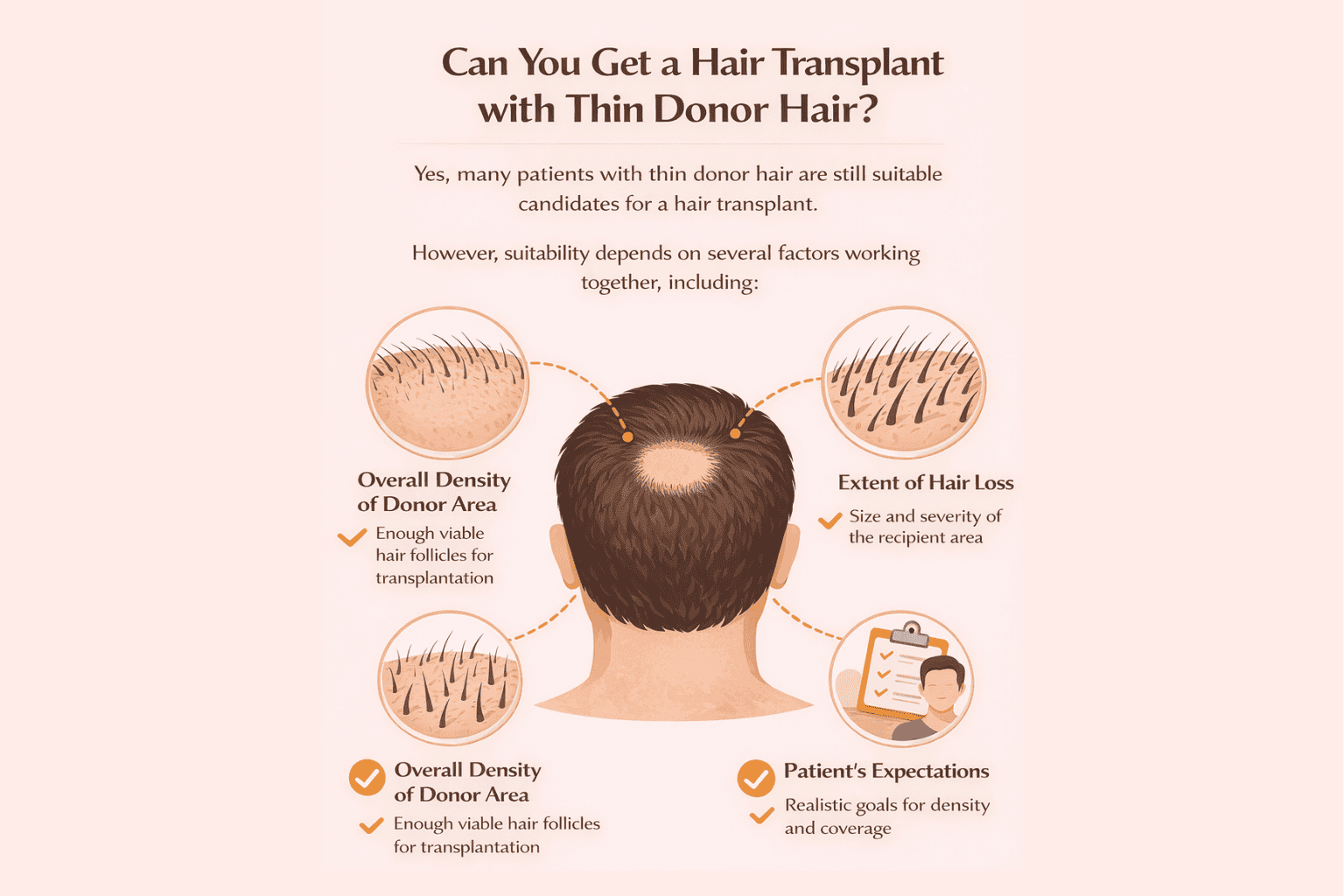
Yes, many patients with thin donor hair are still suitable candidates for a hair transplant.
However, suitability depends on several factors working together, including:
- The overall density of the donor area
- The extent of hair loss in the recipient area
- The patient’s expectations
If the donor area can provide enough healthy follicles, a transplant can produce a noticeable and natural improvement.
The key difference is that expectations and planning must be adjusted. The aim is not to achieve maximum density, but to create a result that looks natural and improves overall appearance.
How Thin Donor Hair Affects Hair Transplant Results
Thin donor hair can influence the outcome in a few important ways.
Visual density
Thicker hair shafts create more coverage per graft. With thinner hair, more grafts may be needed to achieve the same visual effect, which may not always be possible due to donor limitations.
Coverage
If the donor area is limited, it may not be possible to cover large areas at high density. In these cases, priority is often given to the hairline and frontal areas.
Overall appearance
While the result may be less dense than in patients with thicker hair, a well-planned transplant can still look natural and significantly improve appearance.
FUE Hair Transplant with Thin Donor Hair
FUE can still be used effectively in patients with thin donor hair.
However, extraction must be handled carefully to avoid over-harvesting. Because the donor area is more limited, preserving its appearance is essential.
This often means taking a more conservative approach, focusing on strategic placement rather than maximum graft numbers.

Limitations of Hair Transplant with Thin Donor Hair
While a hair transplant is often still possible with thin donor hair, there are some important limitations to understand.
Lower achievable density
Because each hair strand is finer, it creates less visual coverage. This means the final result may appear less dense compared to someone with thicker hair, even if a similar number of grafts are used.
Limited graft availability
If donor density is also low, the total number of grafts that can be safely extracted may be reduced. This limits how much area can be treated in a single procedure.
Need for strategic prioritisation
In many cases, it is not possible to cover all areas at once. Priority is often given to the hairline and frontal region, where density has the greatest impact on overall appearance.
Understanding these limitations helps ensure realistic expectations and better long-term satisfaction.
What Results Can You Expect with Thin Donor Hair?

Although density may be lower, results can still be natural and effective when planned correctly.
The goal is not to recreate full original density, but to:
- Improve overall coverage
- Frame the face with a natural hairline
- Reduce the contrast between hair and scalp
With careful placement, even thinner hair can create a noticeable improvement.
Visual density can be enhanced through:
- Strategic graft distribution
- Layering of follicles
- Working with existing hair
A good result is not defined by maximum density, but by how natural and balanced it looks. Even with thinner donor hair, we can achieve a significant improvement with the right approach.
Steve Ambrose – Capital Hair Restoration – Hair Consultant
Can You Have More Than One Procedure?
In some cases, patients with thin donor hair may consider more than one procedure to gradually build density.
However, this depends on:
- The available donor supply
- How the donor area responds after the first procedure
- Long-term planning
Because the donor area is limited, it must be managed carefully to avoid over-harvesting.
Alternative and Complementary Approaches
When donor hair is thin, a combined approach may be recommended.
Medical treatments
Treatments such as Finasteride and Minoxidil can help preserve existing hair, improving overall density alongside the transplant.
Conservative hairline design
A slightly more conservative hairline can help create a natural look without placing excessive demand on the donor area.
Gradual restoration
In some cases, focusing on key areas first and reassessing later can provide a better long-term outcome.
How to Get the Best Result with Thin Donor Hair
Achieving a good result with thin donor hair depends heavily on planning and technique.
Detailed donor assessment
Understanding the true capacity of the donor area is essential before any procedure.
Realistic expectations
Knowing what can and cannot be achieved helps guide the treatment plan.
Experienced clinic
Precision in extraction and placement is particularly important when donor hair is limited.
Long-term strategy
Planning for future hair loss ensures the result remains balanced over time.
Final Thoughts: Can You Have a Hair Transplant with Thin Donor Hair?

Having thin donor hair does not mean a hair transplant is not possible.
However, it does require a more tailored and strategic approach. The focus shifts from achieving maximum density to creating a natural, balanced result that works with your hair type and donor limitations.
With the right planning, technique, and expectations, a hair transplant can still provide a meaningful and long-lasting improvement.
If you are unsure whether your donor area is suitable, the best next step is to book a free consultation. This allows your donor hair to be assessed properly and ensures any treatment plan is designed to deliver the best possible outcome for your individual case.
Thin Donor Hair Hair Transplant FAQs
Can you have a hair transplant with thin donor hair?
Yes, in many cases, but results depend on donor density and planning.
Does thin hair affect hair transplant results?
Yes, thinner hair provides less coverage, which can affect perceived density.
What is low donor density?
It refers to fewer available follicles in the donor area.
Can thin hair look dense after a transplant?
Yes, with strategic placement and layering techniques.
Will I need more than one procedure?
In some cases, additional sessions may be used to build density gradually.

via Capital Hair Restoration – Hair Transplant https://www.capitalhairrestoration.co.uk/can-you-have-a-hair-transplant-with-thin-donor-hair/


No comments:
Post a Comment